
20 Years in the Trenches of ISP Networks: What Actually Matters
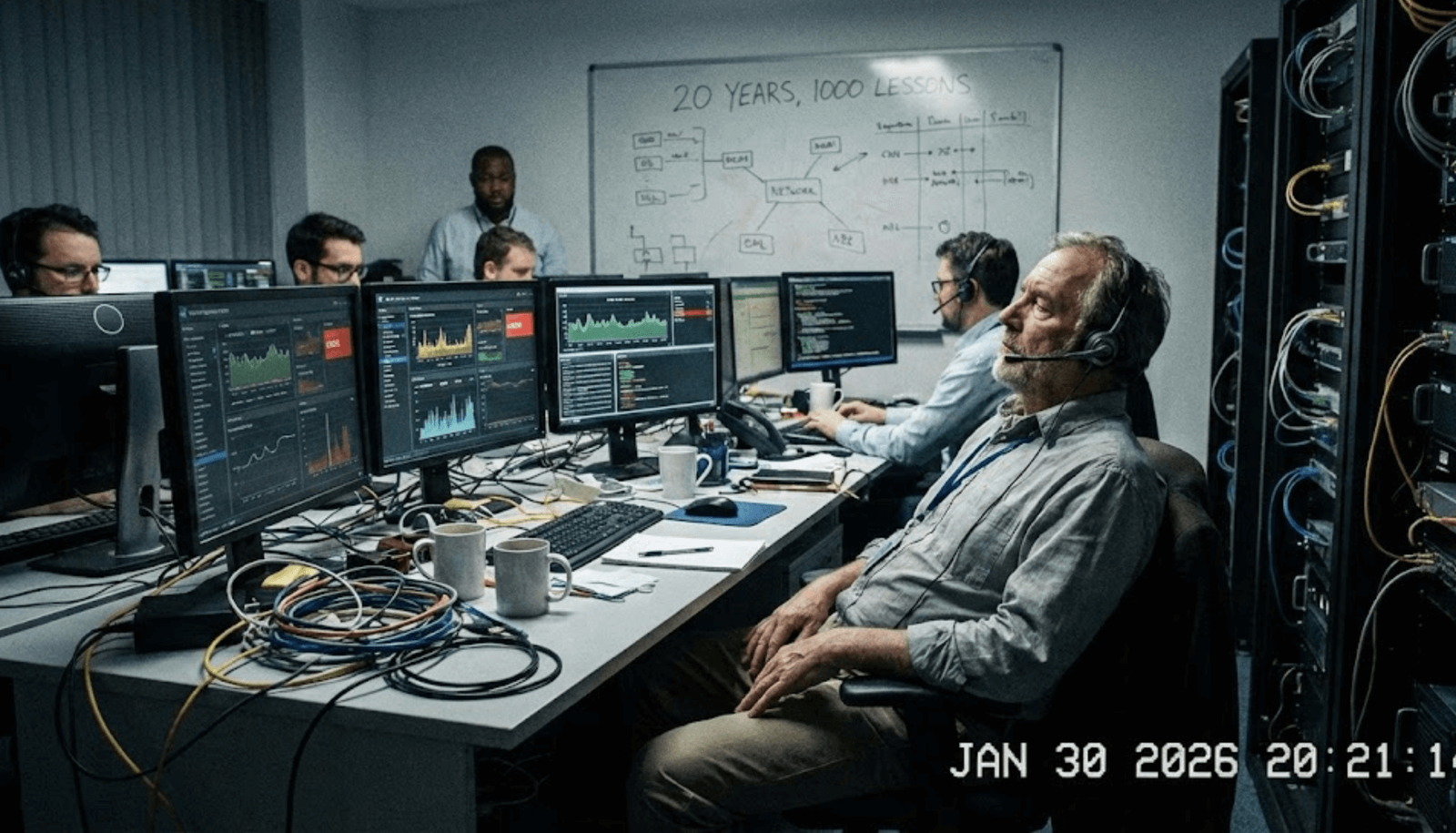
20 Years in the Trenches of ISP Networks: What Actually Matters
Real lessons from building ISPs, running datacenters, fixing outages at impossible hours, and serving thousands of customers.
Twenty years in ISP and network operations teaches you many things.
Most of them not from books.
Most of them not from certifications.
And almost none of them during office hours.
They come at 02:17.
When a core link drops.
When redundancy doesn’t behave the way the diagram promised.
When customers are already calling and your monitoring system is still “green”.
This is not a simple technical guide, but rather It’s a set of scars.
If I had to pass something forward to the next generation of network engineers, operators, and founders, it would be this.
1. Documentation is a survival instinct, not a chore
That “temporary hack”.
That “small change”.
That “I’ll clean this up later”.
You will not remember it.
At some point, you will stare at a configuration you wrote yourself and think:
Who did this?
It was you.
Documentation is not unnecessary bureaucracy as many tend to see it.
It is respect for your future self and for the people who will inherit your network.
Good documentation:
- Reduces outage duration
- Reduces stress under pressure
- Reduces dependency on specific people
Bad or missing documentation turns every incident into archaeology.
If your network only works because a few people “just know how it is”, you don’t have reliability. You have luck.
2. Monitoring without signal is just a landfill of metrics
Anyone can collect data.
Most systems are very good at that.
The hard part is extracting signal.
If your customers alert you before your monitoring system does, you don’t have monitoring.
You have a dashboard wallpaper.
Good monitoring answers questions:
- Is something broken now?
- Is it getting worse?
- Who is affected?
- What changed?
Bad monitoring answers everything except what matters.
Alerts should wake you up only when they deserve to.
Everything else is noise — and noise is dangerous because it trains you to ignore the system entirely.
3. Redundancy is not resilience unless you test it
On paper, everything is redundant.
In reality, redundancy that has never failed is just a theory.
Links fail.
Power fails.
Vendors fail.
People fail.
The most painful outages are not caused by missing redundancy.
They are caused by assumed redundancy.
Failover that hasn’t been tested under real conditions will betray you at the worst possible time.
Maintenance windows, disaster drills, and controlled failures are not optional.
They are how you discover the gap between design and reality.
4. Automation does not remove risk - it moves it
Automation is mandatory at scale.
But automation is also dangerous.
Every script, workflow, or system you automate becomes a single point of fast failure.
When automation goes wrong:
- It goes wrong everywhere
- It goes wrong instantly
- It often goes wrong silently
Automate, but:
- Add guardrails
- Add visibility
- Add rollback paths
- Assume it will misbehave one day
The goal is not blind automation.
The goal is controlled speed.
5. Technical debt always shows up as customer pain
You can postpone refactoring.
You can postpone cleanup.
You can postpone “doing it right”.
What you cannot postpone is the bill.
Technical debt does not stay in the network layer.
It leaks upward:
- Slower troubleshooting
- Longer outages
- Confusing communication
- Burned-out engineers
- Eventually, churn of customers
Customers don’t care why your systems are fragile.
They only experience that they are.
Every shortcut you take today becomes friction someone else will feel tomorrow and this will more often than not impact a customer or two, or more…
6. Growth amplifies everything - including your weaknesses
When you are small, heroics work.
When you grow, heroics become a liability.
Processes that work at 1,000 customers collapse at 10,000.
Tribal knowledge breaks in 24/7 operations.
“Ask that one guy” stops working when that guy is sick, on leave, or gone.
Scale does not forgive shortcuts but actually It exposes them.
Many ISPs fail not because of bad technology, but because they never re-examined habits that no longer scale.
The network eventually reflects the organization behind it.
7. Customer experience is your only durable advantage
In the ISP world, competitors can copy almost everything.
They can buy the same routers.
They can lease the same fiber.
They can match your pricing.
They can clone your self-care app.
What they cannot copy is how you make customers feel.
Helpful cultures are not for sale.
You cannot bolt them on later.
You build them daily:
- In how you respond
- In how you troubleshoot
- In how you communicate during outages
- In how seriously you take even “small” issues
Hardware can be matched.
Bandwidth can be matched.
The feeling of being taken care of cannot.
That feeling is built slowly and destroyed quickly.
The uncomfortable conclusion
After enough years, you realize that most ISP failures are not technical.
They are organizational.
They are cultural.
They are the result of decisions that made sense once and were never revisited.
The real backbone of a great ISP is not just the network.
It is:
- Discipline under pressure
- Respect for the future
- Willingness to question assumptions
- And genuine care for the people who rely on your service
If this post helps someone document one change, test one failover, reduce one alert, or rethink one habit — it will have done its job.
Written by an ISP and IXP operator with 20+ years of experience building networks, running data centers, and operating large-scale broadband infrastructure.