
Best SmartOLT Alternatives for ISPs in 2026
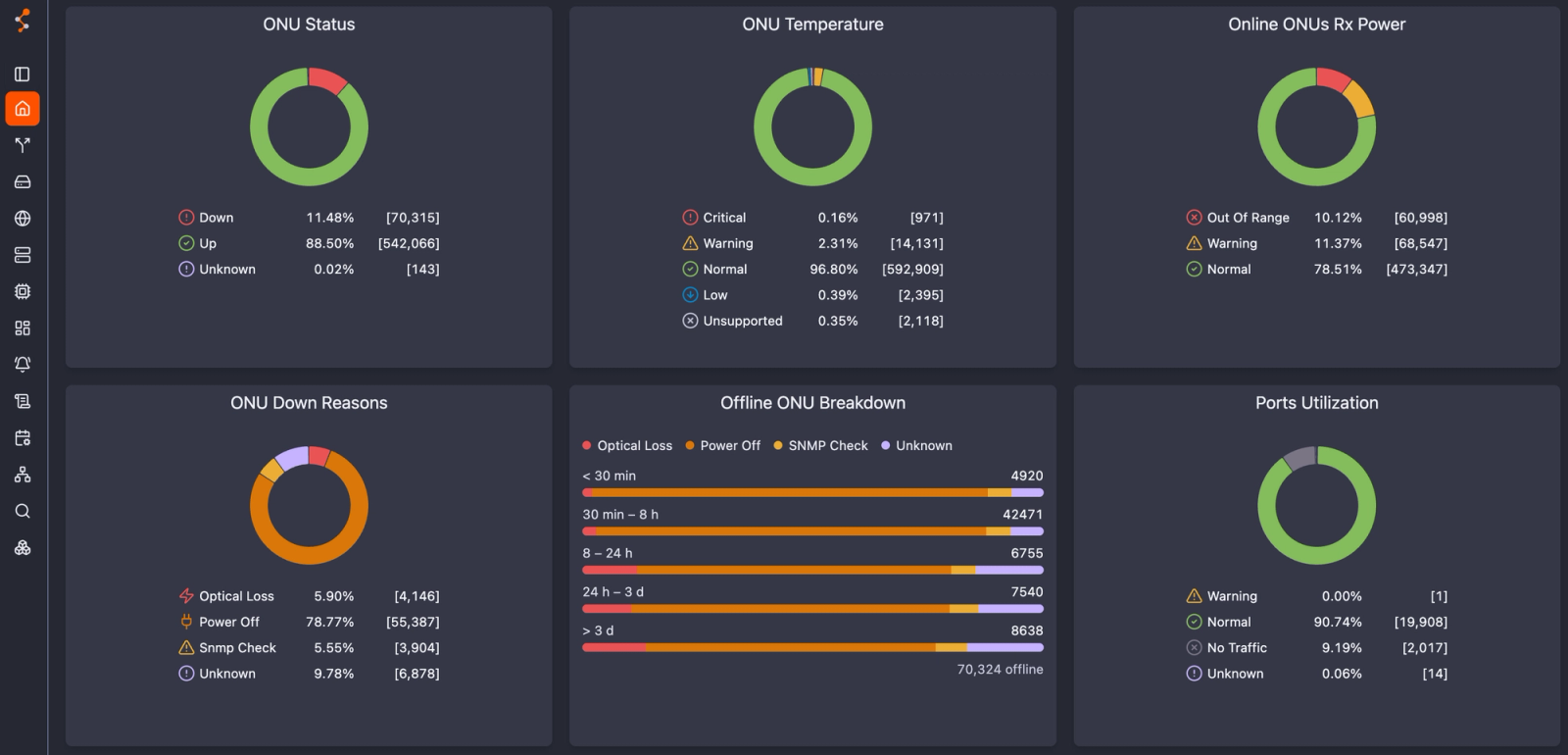
The best SmartOLT alternative depends on what you actually need: full-stack monitoring across your whole network, deeper OLT provisioning, or a self-hosted open-source setup you run yourself. This post walks through five options an ISP would realistically shortlist in 2026, with a genuine verdict for each and a comparison table you can hand to your team.
Full disclosure up front: we build one of the tools on this list (NetSense NMS). We put it first because it is the option we know best, but every other tool here gets an honest verdict, including where it beats us. If you only want the head-to-head, our NetSense vs SmartOLT comparison and the longer SmartOLT alternative guide go deeper than this roundup does.
Why ISPs are looking to move off SmartOLT
SmartOLT earned its spot as one of the early cloud OLT management tools, and plenty of ISPs still run it happily. But the operators who reach out to us while evaluating a switch tend to describe the same handful of reasons.
Here is the honest framing: these are things ISPs migrating to NetSense tell us, not universal facts. Your mileage will vary.
- Feature pace. Switchers say the arrival of new SmartOLT features has slowed relative to where their networks are heading.
- Support responsiveness. The most common single reason we hear cited is how quickly support answers when something is on fire.
- Provisioning-only scope. This one is closer to a published design fact than a complaint. SmartOLT is a provisioning-first OLT management tool that supports ZTE and Huawei OLTs. It is very good at that job. It is not built to monitor your switches, map your topology, or correlate alarms across the whole network. It’s not even truly multi-vendor.
That last point is the real fork in the road. If OLT provisioning is where your visibility ends, everything below or beside the OLT stays invisible until a customer calls. So the question is not just "what replaces SmartOLT," it is "do I want a like-for-like provisioning tool, or do I want to close the monitoring gap while I am at it."
With that in mind, here are the five alternatives worth shortlisting.
1. NetSense NMS
Best for: ISPs that want full-stack monitoring, not just OLT management, in one cloud platform.
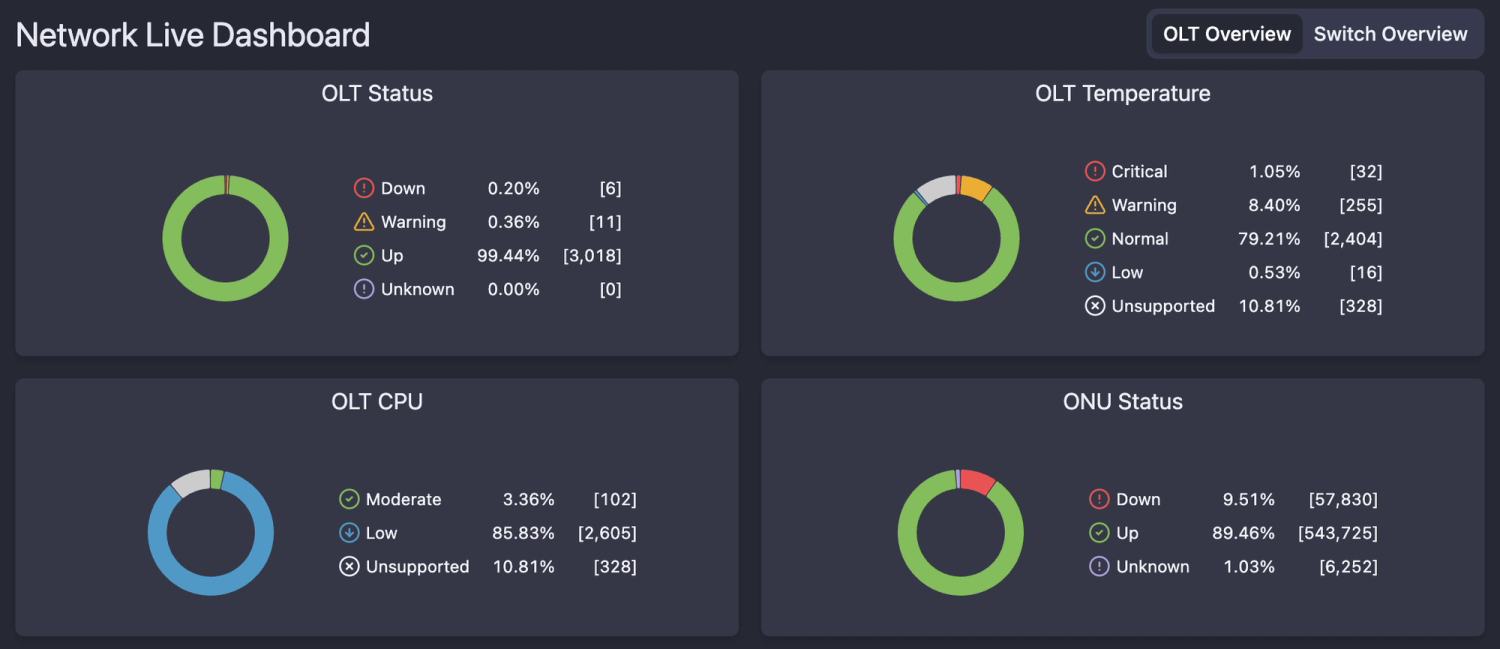
NetSense is a cloud NMS built specifically for FTTH ISPs. It monitors OLTs from 15+ vendors (Huawei, ZTE, Nokia, Fiberhome, Genexis, Syrotech, VSOL, Optilink, and more), plus your switches, routers, and BNGs, with port-level SNMP detail. It renders your network topology as live maps, built from Netbox sync or defined device links with on-demand per-device views, and layers a TR-069 ACS over the top for customer-side CPE and WiFi visibility.
The design bet is coverage. Most customer-affecting faults do not happen on the OLT itself, they happen on the transport, the switch, or the in-home WiFi. An OLT-only tool cannot see those, so NetSense pulls the whole path into one view. Alert correlation then turns one fiber cut into one alert instead of 400, which is the difference between a NOC that catches incidents and one that drowns in noise.
Where NetSense is honestly not the right pick: if you want a pure one-click OLT provisioning tool and you do not care about switches, topology, or CPE, NetSense is more platform than you need. It is monitoring-focused, not a provisioning-first replacement.
- OLT depth: per-ONU Rx/Tx signal history, partial PON failure detection, QoE scoring, 30-second polling on critical metrics.
- Beyond the OLT: switch and router monitoring, live topology maps, built-in TR-069 ACS with WiFi telemetry and zero-touch provisioning.
- Cadence: monthly releases documented in a public changelog, so you can check the pace before you commit.
- Proof at scale: running across 4,500+ OLTs, 6,000+ switches, and 1.4M+ ONUs, including at Excitel, one of India's largest FTTH ISPs.
There is a free-forever tier up to 1,000 nodes (no card, no time limit), so you can point it at part of your network and see what auto-discovery pulls in before you decide anything.
2. AdminOLT
Best for: provisioning-centric teams, especially in Latin America, that want strong mobile-first OLT management.
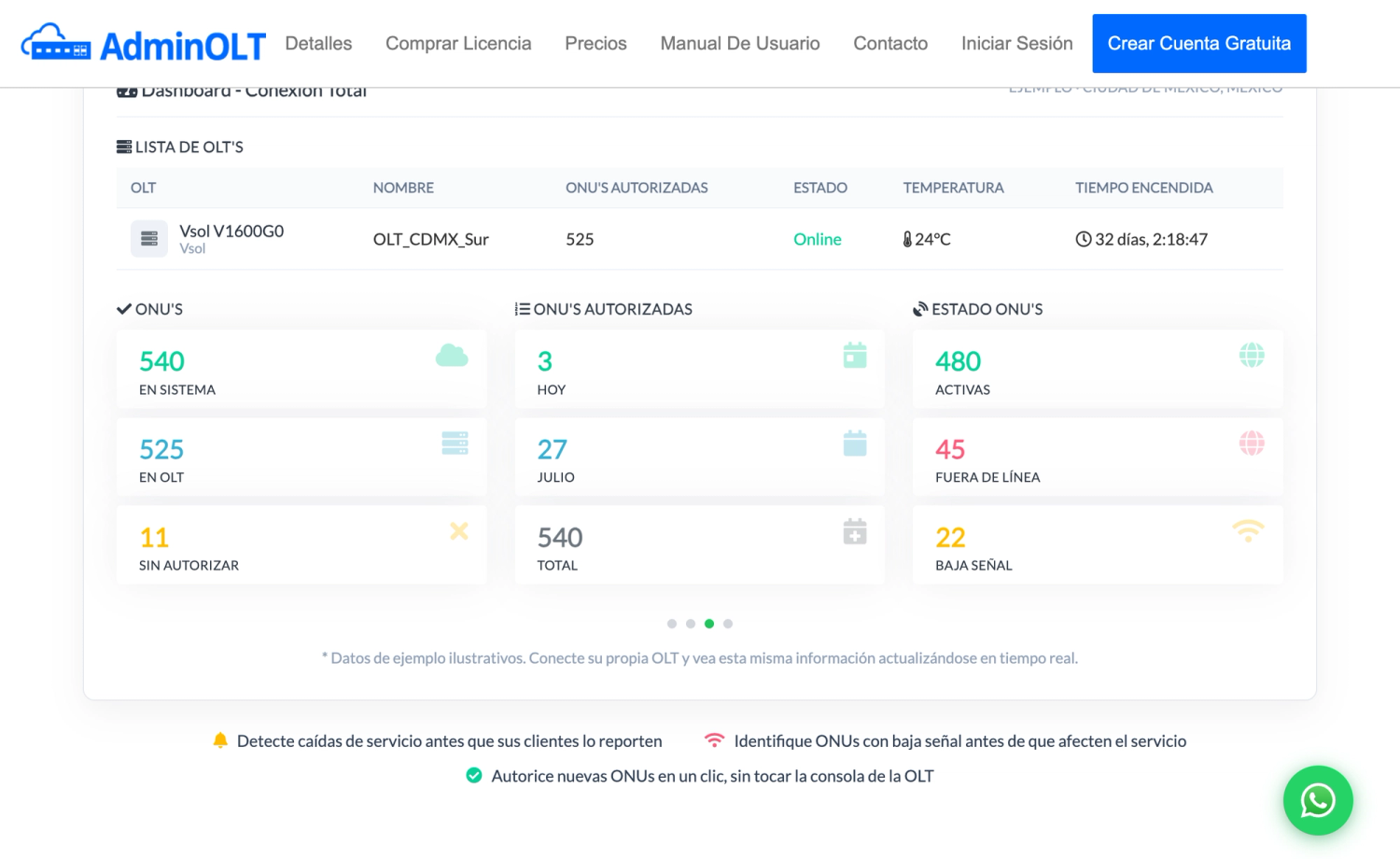
AdminOLT is a provisioning-focused OLT management platform that has grown a solid following, particularly across Latin American ISPs. It supports eleven OLT brands across two pricing tiers, ships mobile apps for field teams, and has been adding AI features. If your day-to-day pain is provisioning ONUs quickly from a phone in the field, it is a capable tool and a natural SmartOLT-style replacement.
The trade-off is the same category limit as SmartOLT: it is provisioning-first, not a monitoring platform. It will manage and provision your OLTs well, but it is not designed to monitor your switches, correlate network-wide alarms, or map topology beyond the OLT layer. If you want to stay in the provisioning-tool category and just want a livelier vendor, AdminOLT belongs on your list. If you are trying to close the monitoring gap, it does not do that.
Some concrete numbers from their current pricing page: the eleven brands split across two tiers. Huawei, ZTE (including Titan), VSOL, and FiberHome sit on the Pro tier at 25 USD per OLT per month, while WOLCK, TP-Link, C-Data, HIOSO, Optronics, and HSGQ ride the cheaper Esencial tier at 15 USD, billed quarterly. Every plan is per OLT with unlimited ONTs, and there is a 7 day demo limited to a single OLT. The AI features (automated log and consumption analysis) are rolling out for Huawei first, and the platform ships geolocation of ONUs, NAPs, and OLTs on Google Maps with route planning for field crews.
3. OpenOLT
Best for: GPON-focused operators who want vendor-specific management workflows and flexible deployment.
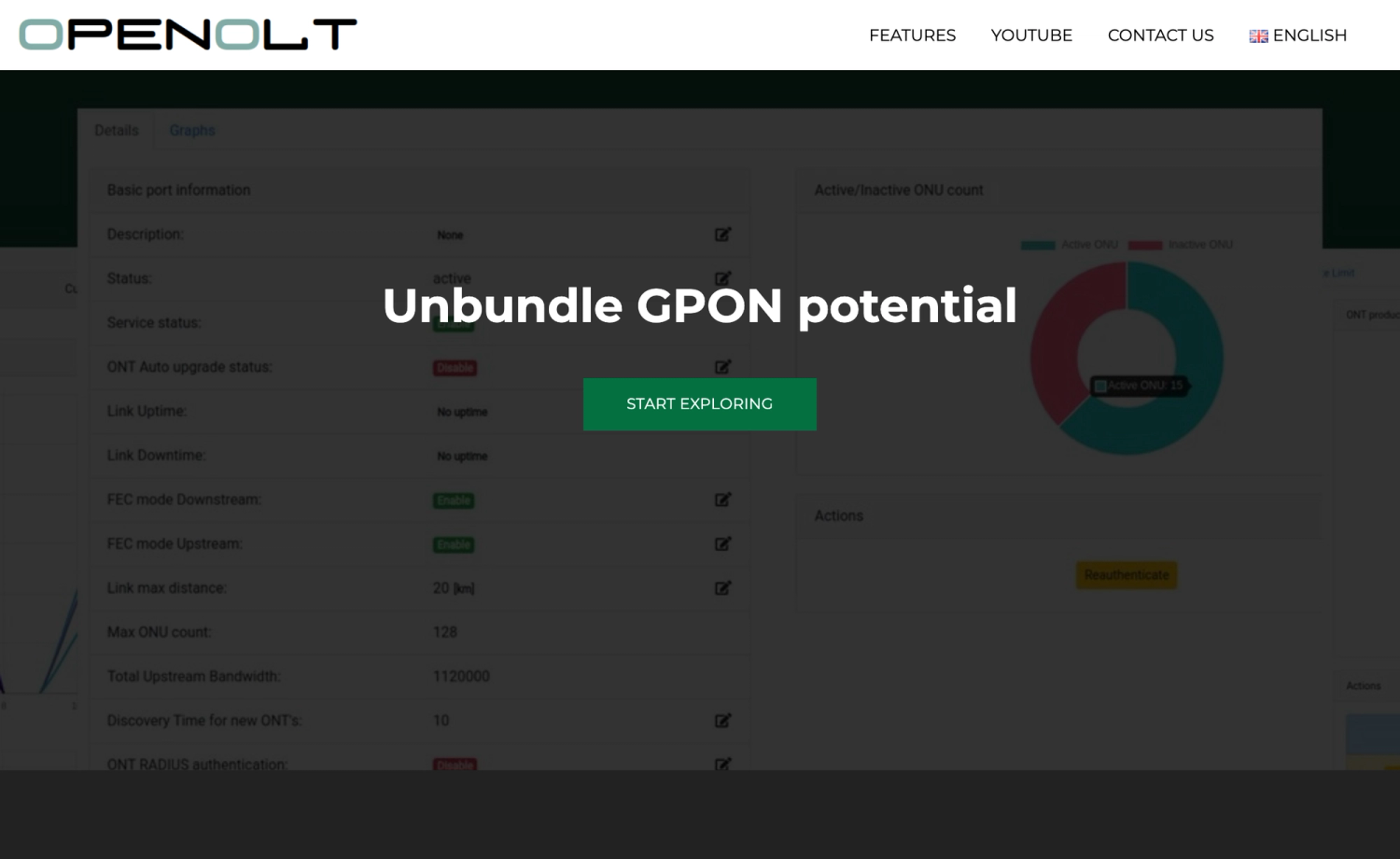
OpenOLT is aimed squarely at GPON management, with vendor-specific workflows for OLTs like Nokia, DASAN, and Zyxel. It offers both cloud and on-premise deployment, which matters if you have data-residency requirements or simply prefer to keep management in your own environment.
Its strength is that per-vendor focus. Where a generic tool gives you a lowest-common-denominator view, OpenOLT leans into the specifics of the GPON gear it supports. That also defines its edge: it is GPON management, not full-stack monitoring. If your fleet is GPON-heavy and centered on the vendors it targets, and management (not cross-network monitoring) is the goal, it is a reasonable pick. It will not monitor your switches or give you a correlated view across the whole network.
The details back the positioning. The Nokia page targets ISAM FX chassis (FX-4, FX-8, FX-16) with a web UI that replaces Nokia's local-client AMS workflow, and the DASAN-Zhone coverage spans both GPON and XGS-PON. Two features stand out: a virtual OTDR that helps localize passive network problems without rolling a truck, and scheduled ONT firmware upgrades, with a JSON and XML REST API for billing integration on top. Pricing is not published anywhere on the site, so budget a sales conversation before you can compare costs.
4. WildcoreDMS (wildcore.tools)
Best for: teams that want a self-hosted, open-source-flavored platform they run and control themselves.
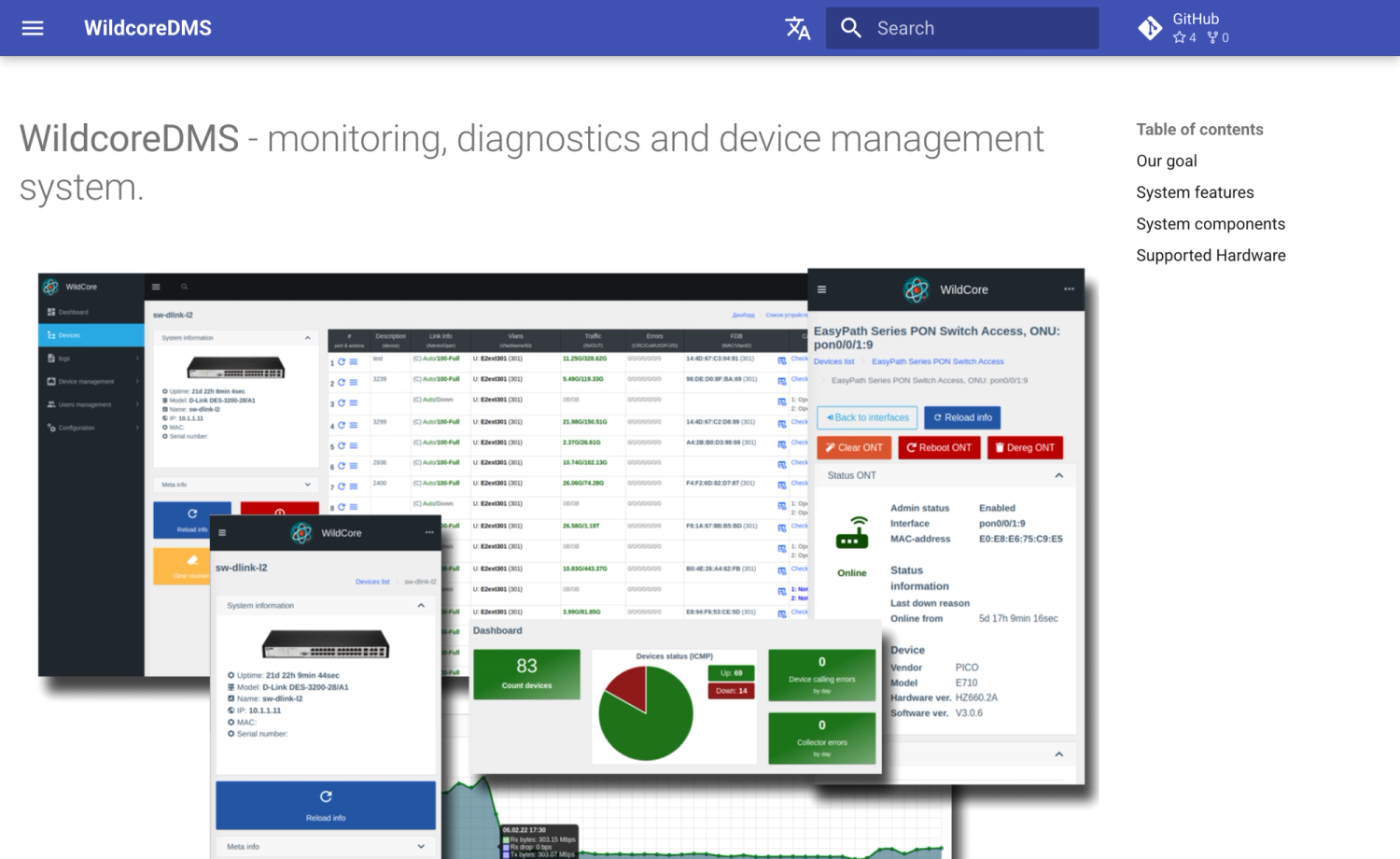
WildcoreDMS (now at wildcore.tools) is a self-hosted ISP management platform with a following in Eastern Europe. It ships as Docker containers, has role-based access control, a progressive web app for mobile use, and English documentation, which lowers the barrier for teams outside its original region.
The appeal is control. You run it on your own infrastructure, you own the data, and you are not tied to someone else's cloud. That is also the cost: self-hosting means you carry the deployment, upgrades, backups, and uptime. If your team has the engineering time and prefers to own the stack, WildcoreDMS is worth a look. If you would rather someone else run the platform so your engineers stay on the network, a managed cloud tool fits better.
The supported hardware list is long for a self-hosted tool: BDCOM, C-Data, GCOM, Huawei MA56xx and MA58xx, V-SOL V1600, and ZTE C300/C320/C600 OLTs, plus switches from D-Link, Cisco, HP, Juniper, MikroTik, and Eltex. The system is modular, so you enable only what you need: ICMP pinger, FDB history, ONT registration templates for Huawei and ZTE, Telegram and email notifications, and billing integrations for MikBill and NoDeny. Pricing is transparent and unusually low, from 0.01 USD per interface per month with a 10 USD monthly minimum for individual operators; international legal entities pay 0.05 USD per interface with a 500 USD monthly minimum, so read the prices page carefully before planning around the headline rate.
5. Zabbix + community OLT templates
Best for: DIY and open-source shops with engineering time to build and maintain their own monitoring.
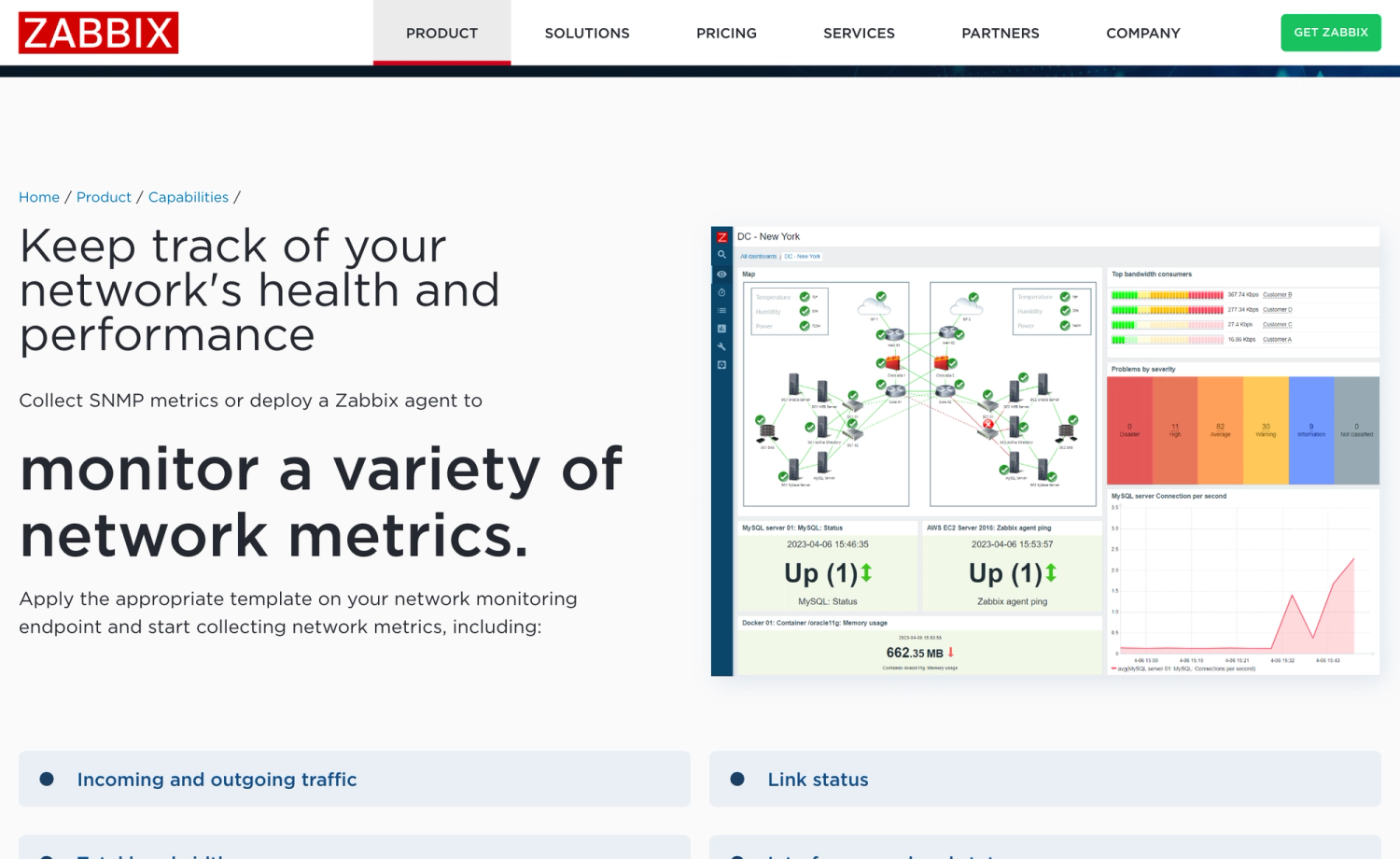
Zabbix is the strongest open-source answer on this list. It is a mature, general-purpose monitoring system, and the community has published OLT templates for common gear like Huawei and ZTE. Wire those templates into a Zabbix install and you can get real OLT metrics with no license fee.
The honest picture is the effort behind it. Those templates are community-maintained, which means you are responsible for fitting them to your exact OLT models, keeping them current as firmware changes, and self-hosting Zabbix itself at scale. There is no FTTH-specific layer out of the box: no partial PON failure logic, no per-ONU QoE, no TR-069 ACS. You build the ISP-specific parts yourself on top of a general engine.
On cost, the software is genuinely free under the AGPL with no per-device fees; what Zabbix sells is support, from Silver at 245 EUR per month up to enterprise tiers, plus a hosted Zabbix Cloud with a short free trial. The OLT story is strictly community, and you can see its shape on their own integration pages: community templates for ZTE C300 and C320 that pull ONU RX/TX signal levels and SFP temperatures, and a community MA5600 GPON template for Huawei on GitHub. None carry the official template badge, which is the maintenance trade-off in one sentence.
For a shop with strong in-house engineering and a preference for open source, that is a feature, not a bug. For a lean NOC that wants FTTH monitoring to work on day one, the maintenance burden is the reason most operators eventually move to a purpose-built tool.
Comparison table
Tool | Focus | OLT vendors | Beyond-OLT coverage | Deployment | Best for |
|---|---|---|---|---|---|
NetSense NMS | Monitoring | 15+ (Huawei, ZTE, Nokia, Fiberhome, Genexis, VSOL, and more) | Switches, routers, topology, alerting, TR-069 ACS | Cloud SaaS (managed) | Full-stack ISP monitoring |
AdminOLT | Provisioning | 11 brands (two tiers) | None (OLT/ONU only) | Cloud | Mobile-first provisioning, LatAm |
OpenOLT | GPON management | GPON vendors (Nokia, DASAN, Zyxel) | None (GPON focus) | Cloud + on-prem | Vendor-specific GPON workflows |
WildcoreDMS | ISP management | Vendor set varies | Management features, not full monitoring | Self-hosted (Docker) | Self-hosted, team owns the stack |
Zabbix + templates | Monitoring (DIY) | Community templates (Huawei, ZTE) | Anything you build yourself | Self-hosted | Open-source shops with engineering time |
How to choose
Start with the fork from the top of this post: provisioning tool or monitoring platform. If you love SmartOLT's job and just want a more active vendor, AdminOLT or OpenOLT keep you in the provisioning lane. If the real problem is that faults stay invisible until a customer calls, you want a monitoring platform, and that is a different category of tool.
From there it comes down to who runs it. WildcoreDMS and Zabbix put the platform in your hands, which is great if you have engineering time and terrible if you do not. NetSense runs it for you and covers the whole path from OLT to CPE, which is the trade we optimized for.
Whatever you pick, use the checklist in our SmartOLT alternative guide to score every option (including ours) on multi-vendor support, switch monitoring, topology, alert correlation, and TR-069. The point of the checklist is to keep the evaluation honest.
If you are weighing a move and want to see what full-network visibility actually looks like on your gear, spin up the free tier or book a live demo and we will walk your fleet with you. And if you are already a NetSense customer: the changelog is worth a refresh, there is usually something new since last month.
Frequently Asked Questions
- What is the best SmartOLT alternative?
- There is no single answer, because "best" depends on your goal. If you want to close the monitoring gap and see your whole network (OLTs, switches, topology, and CPE) in one place, a full-stack monitoring platform like NetSense NMS fits. If you want a like-for-like provisioning tool, AdminOLT or OpenOLT stay in that lane. If you prefer open source and have engineering time, Zabbix with community templates or self-hosted WildcoreDMS are the DIY routes.
- Is there a free SmartOLT alternative?
- Yes, with trade-offs. Zabbix is free and open source, and community OLT templates for Huawei and ZTE exist, but you self-host it and maintain the templates yourself, and there is no FTTH-specific logic out of the box. WildcoreDMS is self-hosted and lowers cost that way, at the price of running the platform yourself. NetSense has a free-forever tier up to 1,000 nodes with no card and no time limit, which is enough to monitor part of a smaller network or trial it on a segment before committing.
- Can I run a new tool alongside SmartOLT during migration?
- Yes, and we recommend it. Monitoring tools like NetSense are read-only against your devices over SNMP, so they run alongside SmartOLT without touching your provisioning workflow. Customer-side CPE visibility through the TR-069 ACS is set up as its own onboarding step. Point the new tool at your OLTs and switches, let device discovery inventory the network in hours, and keep provisioning in SmartOLT until you are confident. Migration is the worry we hear most often and the one operators consistently overestimate.